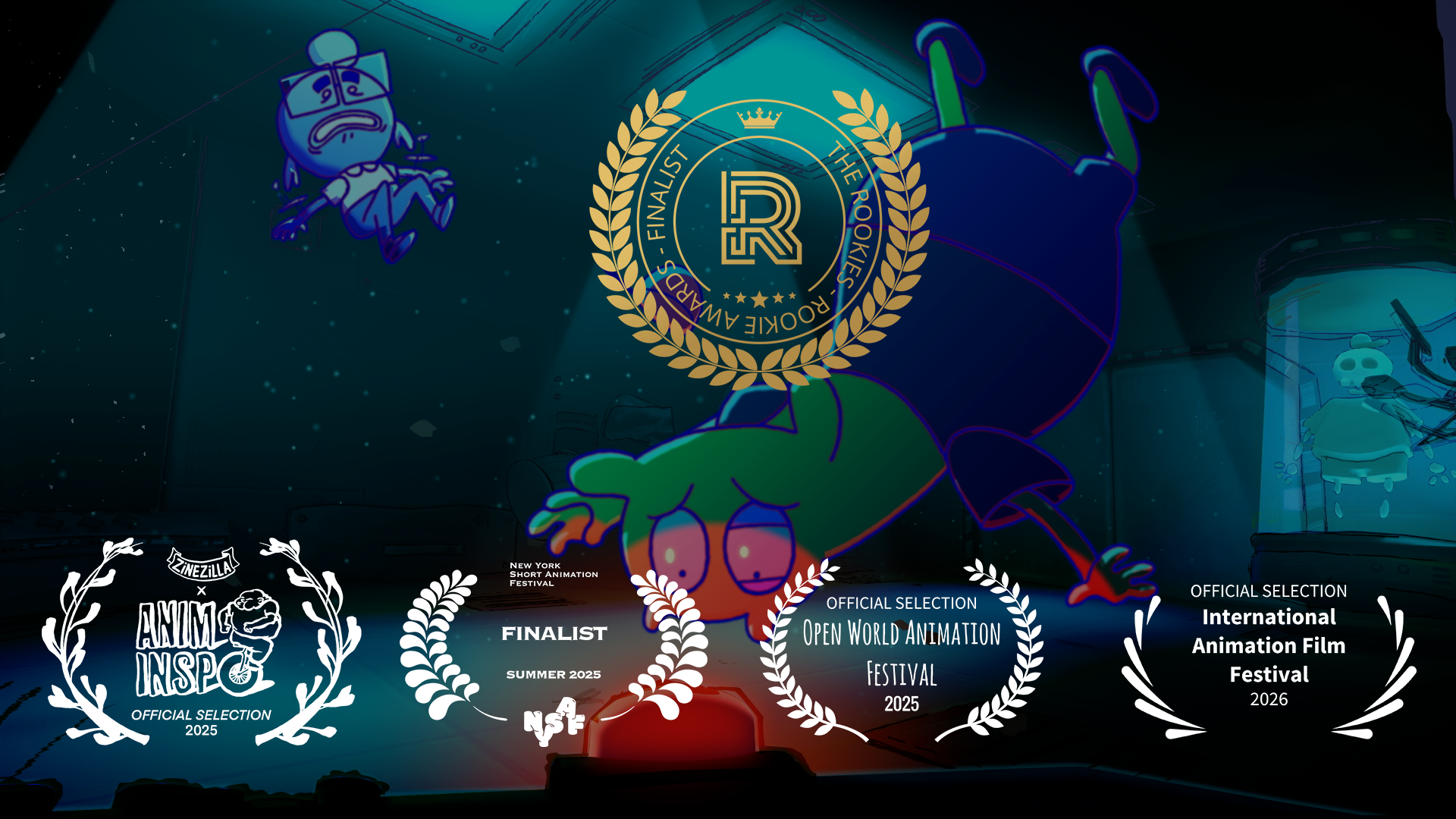
Space Sweepers (Lilian Han Morze) is a three and a half minute 2D-3D hybrid animated film, with animation done in Toonboom and 3D work done across Maya, Substance Painter, and Blender. As I write this, it is still on its festival run. Give it a few months and hopefully it will be released to the public!
I produced this film over a 10 week period to take it to completion, working with the director and four artists to bring it to life. Although familiar with the CG pipeline, having done some creative work of my own, this was my first opportunity to produce it – and work out how to fit it into a hybrid pipeline, no less! So before anything else, I took a moment to brush up on my knowledge of the pipeline for CG environments via Dream Farm Studio’s online guide, which you can find here.
Important context for this blog post is in what way the film was hybrid. The predominant use of hybrid was to have CG backgrounds with 2D animated characters composited on top. In some shots the CG assets would be animated, so there was some 3D animation, albeit nothing that required any rigging. We also played around with some pixelation on a couple of shots, but it was so quick and simple to do in this context that it didn’t require any extra scheduling to allow time for it.
Whilst in the industry you can simply hire people as and when they are needed in the project’s timeline, as a student it is quite different – you are given a team of people to work on the project right from the very start until the end. This presents the challenge of deciding the best way for each person to spend their time when, normally, they wouldn’t be brought on to the project until a later date. I’ll be running through how I kept my team members busy at all times, and then discussing how I would do things differently now that I have more experience under my belt.
Week 1
So, how did I utilise my team and get them all working in the very first week? We had two CG artists and four 2D artists (myself included). The pitch already had a lot of content before being greenlit, including an animatic, turnarounds, and an interior environment blueprint. We knew that the location for the film, which was only one room, would not be changing. With this in mind, I had the CG artists make a start on the blockout that we would need for our 2D animation whilst the 2D artists refined the storyboards, turnarounds, and became acquainted with the film’s artstyle. I also put out a crew call for a sound designer, composer, and voice actors.
Week 2
With the blockout completed, 2D artists began animating. As we only had two people on the CG side, I asked for them to run a quick refresher session for the rest of the team on how to set up cameras within the blockout file on Maya so that the animators could create the cameras for their own shots – this saved our CG artists from interrupting their work by hopping in and out of different Maya files just to add a camera and make an export, and meant that no 2D animators were stuck waiting on anybody else when they wanted to move on to a new shot. I knew that there was still potential for parts of the storyboard to change at this point, so for the 2D animation, I assigned the shots most vital to the fundamental story which I felt were at the lowest risk of being cut (and thankfully, none of them were). The pipeline I established was that one animator would be responsible for both keys and tweens in a single shot, and then the shots tended to be traded around – most often to the director, who knew the style the best! – for clean up. We all then chipped in for colouring.
On the CG side, things had worked out quite conveniently: of the two artists, one was specialising in modelling and animation whilst the other was specialising in texturing. With that in mind, I had the texturing artist model our exterior environment, which was just a spaceship, whilst the modelling-focused artist began to take the props in the blockout from low-poly to the finished model. This meant that once the ship had been modelled, our texture artist already had a backlog of objects to texture and the two were not constantly playing catch-up.
Weeks 3-5
Animation and modelling/texturing continued. We made some major animatic changes at the beginning of week 3, which didn’t alter our main plot points but did rework a lot of other shots: I was glad I had only assigned important shots in week 2! After having made the decision to ‘fix’ every issue we could come up with sooner rather than later, the team as a whole felt much more confident in the film’s animatic.
We time locked in week 4 and I sent the animatic off to the composer, with the note that specific shots might still be altered. After a few minor tweaks, we sent a picture-locked version to the composer and sound designer in week 5. This is also the week in which we recorded our voice actors!
By the end of week 5, our modeller had largely finished up their work. I moved them down the pipeline and onto animation for the props, which was then done alongside the texturing for the next couple of weeks.
Weeks 6-8
Progress on the CG environment slowed down in these weeks, as our CG artists kept running into Maya issues – not to be helped, but frustrating nevertheless. Thankfully we were in a good place when this happened, so it didn’t impact our ability to finish to deadline. Our 2D animators finished up at the end of week 8. I tested our compositing process, which originally saw me adding all lighting in comp, however the texture artist and I streamlined this by arranging for them to add in some lighting in the Maya scene and then export a lighting pass of each of the shots for comp to work with.
By the end of week 8, production had been completed. Post-production began!
Weeks 9-10
These final two weeks focused on two primary tasks: compositing, and adding Blender’s grease pencil to the CG environments. As the grease pencil could be exported transparently and added to comp files at the end, these two tasks were done largely alongside one another. I also had our sound designer and composer finish off their work so we could put everything together at the end. The grease pencil exports were added to each shot’s comp as the grease pencil was completed, and so there was no large batch of grease pencil to tackle at the end.
And finally, with everything completed, the film was finished!
Evaluation & what I would do differently
The Good
The distribution of work between our two CG artists, and having them both work on separate things alongside each other rather than both working on the same step of the pipeline was, I believe, a wise choice. It meant that we weren’t waiting until half way through the timeline to figure out any texturing issues, and allowed us to have a clearer idea of the finalised look earlier.
I also think that with our team being the size that it was, having the grease pencil be done alongside compositing worked well. Ideally, of course, it would be done beforehand, but with only two CG artists I don’t believe delaying any other part of the pipeline in order to do grease pencil earlier would have been a good decision.
Ensuring that the first batch of shots I assigned to the 2D animators were the ones we felt most confident wouldn’t be changing undoubtedly saved us from having to scrap and then re-do a lot of work, especially considering the major revisions made in week 3.
What could be improved
On the film I’m currently producing, I will assign one person to keys and then give it to somebody else for inbetweens. For a student project, I have found that this works much better. Not only do the finished shots tend to come out more consistent, but I’ve generally seen an increase in work output. If I had gone with this workflow, I would have only assigned keys in the first week of animation. We were very lucky that the changes made at the start of week 3 didn’t lead to us scrapping any work – often it would, and with those shots being fully roughed rather than just keys, it would have been frustrating to lose them. Assigning only keys at this earlier stage would have been a safer move.
On the topic of the changes we made – these occurred too late in the timeline for my liking! I was aware that our film was a minute longer than it was supposed to be for that module, so was keen for everybody to get stuck into working on it. Now I understand that these minor issues can often lead to bigger ones, and that it is certainly worth spending the start of the project making sure you’re 100% confident in what you’re making before going into production.
Conclusion
Regardless of what went well and what didn’t, the whole experience undoubtedly taught me a lot of lessons. There’s the timetabling side of things, of course, but equally as important are the soft skills involved in production management – and for me, this was the first project where I felt like, socially, I comfortably fell into my role as producer. I really started to understand the important parts of how you interact with your team, how you encourage them whilst maintaining respect, and how to effectively get the best out of everybody.
On a final note, Space Sweepers is the first film I’ve produced that has been on a festival run and I’m delighted that it has been shown in festivals not only in the UK but in Europe and the states too. Additionally, it was a finalist in The Rookies Awards 2025 – Best 2D Animated film, which is a global competition for young filmmakers. How very exciting!