Falmouth University Alumni Panel 2025
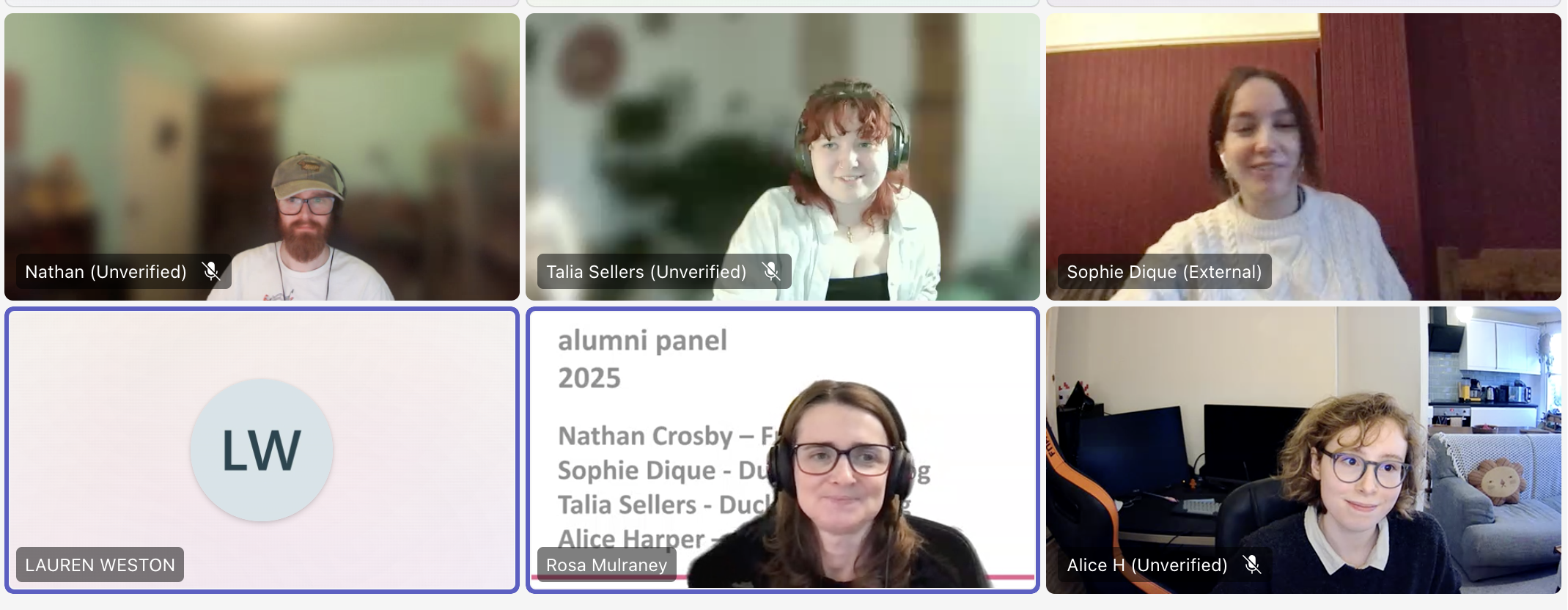
As a student, there’s always the looming thought of what to do after university — especially having studied a degree as multi-faceted as Animation. The Animation course at Falmouth invites graduates back every year to discuss their work, so current students can gain insight into the industry. Find out here a bit more about what may await us on the other side of our degree…
Introductions
Nathan Crosby – Framestore — Creature FX TD
Nathan Crosby is based in Somerset and works as a creature FX TD. What does that entail? you may ask. So did many of us! As explained by Nathan, a creature FX TD takes an animated creature rig and adds things like muscle, cloth and fur simulations to create appropriate and realistic movement from whatever it is they’re working on – be it Sonic the Hedgehog or Paddington Bear. A bit niche compared to what we’re taught on the course, for sure! But certainly interesting to learn about. As animation students, we’re often told that we may end up in jobs that we don’t even know exist yet: Nathan’s role just goes to show that!
In fact, Nathan started off as a web developer when he left university, helping a smaller artist get up and running whilst on the lookout for other work. He didn’t want the lifestyle of an animator, so filled his portfolio with compositing work, environment art etc., all of which are skills we also have the opportunity to develop here on the course alongside animation. Nathan’s career really launched when he was contacted by the people at MPC’s Technicolour Academy, who invited him to apply to their course.
At Technicolour Academy, Nathan was taught how to bring his work to a much higher level, with Nathan describing it as giving him “a much bigger and better understanding of how the industry works”. Whilst he didn’t get a job as an environment artist off the back of the academy, he did get a role as a creature FX artist on Sonic the Hedgehog 2 – and thus, his journey as a creature FX artist began.
Now, having worked on a wide range of films including Wicked, Paddington in Peru, and How to Train Your Dragon, Nathan offers some advice on starting out:
“Take notes! Learn how your company works; take notes of the tools they’re telling you to use on a daily basis, and then when someone tells you something that rings a bell you’ll have something to go back to. Don’t be afraid to go through company documentation too! It’s there to help you.”
Nathan also makes the point that networking is incredibly helpful, advising on building a LinkedIn presence and making connections wherever you go:
“Contracts can be short – build connections. Make sure when you’re at a company to be genuine, yourself, and a team player.”
Sophie Dique and Talia Sellers — Duck Called Dog — Founders
Sophie Dique and Talia Sellers both graduated with the class of 2022. The duo first officially came together in their final year on the Animation BA (Hons) course at Falmouth, in which they co-directed the short film Scenes of the Absurd (2024) – a film which did incredibly well at festivals. Leaving university just after and finding a lack of job opportunities, the two put their heads together and decided to found their own production studio: thus, Duck Called Dog was born.

Whilst both have their specialisms – Sophie’s being animation and lighting and Talia’s being puppet and set making – both are involved in all stages of production. In fact, the studio is comprised of just the two of them! Sophie shared that she had originally wanted to have a traditional career in stop-motion animation, but realised it wasn’t a lifestyle she would necessarily enjoy. Instead, she found being able to do a variety of things is much more engaging.
“It’s been so much fun and I wouldn’t change it for the world” — Talia
Of course, starting your own company isn’t as simple as pressing a button. Networking, applying for grants, piles of paperwork: these are all things which the pair warns you should be prepared for. In Duck called Dog’s first year, the priority was on creating content rather than making money; although difficult, this allowed the studio to begin to establish itself. Talia also completed a business course, which she jokingly describes as “not exactly our forte” but she surprised herself by finding it incredibly interesting, so much so, in fact, that she recommends that students research business practices and operations before leaving university. This way, they have a baseline understanding of what to expect in the industry. An accountant, too, is apparently essential!
Alice Harper — Blue Zoo — 2D Background Artist
Alice Harper is a background artist and illustrator, based in Brighton, who largely works in the children/preschool age bracket of 3-4 years. She tells us a little bit about her path from leaving university to her current job:
“I got into the industry through a little bit of networking and a little bit of interning here and there.”
After graduating in 2020, Alice took part in various internships to kickstart her career. The first one she describes as “a bit of an odd one”; it was for a French company which advertised themselves through Facebook. She also took on some low-paid small jobs helping out independent directors to put together pitches. However, she found her first ‘proper’ job through the networking event ‘Overlap Social’ in Birmingham. The man who runs it, Alice tells us, is brilliant.
Rosa, who is chairing the alumni panel, chimes in at this point to reinforce Alice’s sentiments: “Networking events can be really helpful and lots of festivals and communities put them on. There’s probably lots you can find on social media – you never know when that connection will lead to your next job.”
Alice then discusses her portfolio with us, and the process of finding a job as a background artist. The portfolio is critical – if you have the time to focus on it and make your own work for it (as opposed to working other people’s projects), it’s worth it. Because she was keen to work in children’s media, Alice’s personal work focused on pieces that matched the styles often seen in this category. She also tells us of the benefits of including work which you’ve taken from start to finish, as it shows that you can handle layouts and values as well as rendering and lighting. Having a multitude of studies, too, can show studios that you have a good observational eye – although, she jokes, these can be boring to do!
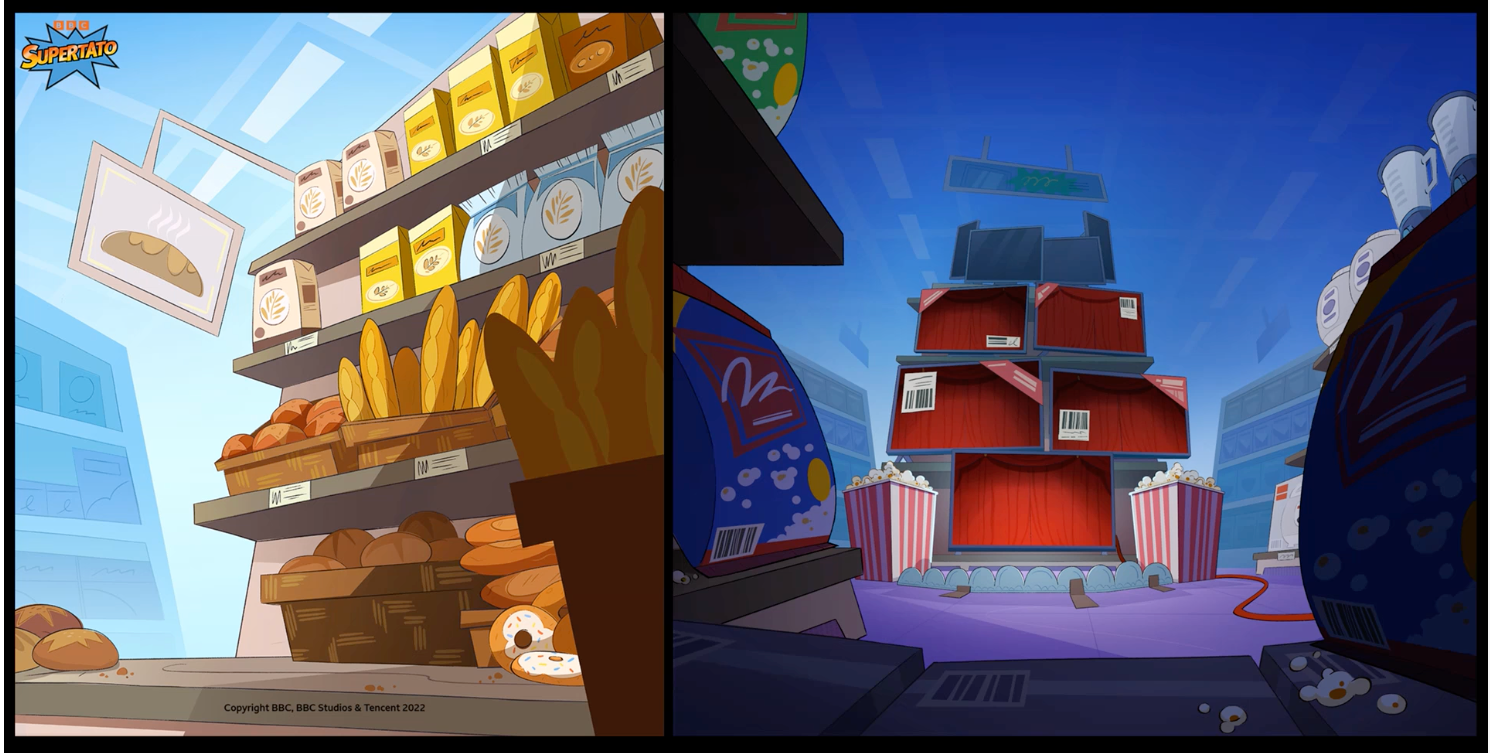
Some of Alice’s backgrounds
Another handy recommendation that Alice offers is connecting with recruiters, production staff and art directors on LinkedIn. Whilst she loves chatting to students, she says she always directs them to Recruitment: “those are the people who can actually help you land a job.”
Questions
After hearing from the panel, Rosa opened the floor to questions from students. It’s always helpful to hear from people who have succeeded in what you’re about to go through, so questions were aplenty…
What can people be doing now, whilst still students, to prepare for the industry?
“Just make stuff”, says Nathan – very simple indeed! Engaging in creative activities, no matter what they may be, will always lead to transferable skills. Nathan paints miniatures in his spare time, and he’s found the skill to be helpful when he’s at work too. It could even just be a matter of sparking up a conversation when networking: every little helps! Alice chimes in, telling us that if you’re passionate about something, everyone will be able to tell, and there’s nothing better than being excited about something to get other people on board.
It’s easy to see the industry as this mythical, far-off thing whilst a student: any advice for students who may feel that they’re not good enough?
A chorus of agreement rings out from the panel: everyone knows that feeling!
“Sometimes you just have to be okay with feeling that. You have to realise that everyone has that and you are good enough because you’re here.” — Sophie
There is a general consensus that attitude is just as important as skill level, if not more so, with Nathan highlighting that he didn’t know how to do his job when he was given it but his employers knew he would be willing to learn and capable of adapting. Alice agrees, smiling whilst telling us that enthusiasm, commitment, and the ability to parrot a style are all more relevant than an incredible portfolio.
Talia delivers some candid advice to round us off on this question: use negative feelings as a driver to keep learning and building your skills. The industry may be a bit rocky at the moment, and jobs may be hard to come by, but keep the determination and keep working.
…Or, Sophie pipes up, make your own jobs and pretend there isn’t an issue!
Internships: what’s good to know?
There will definitely be summer internships at the big London studios, Alice assumes, and it might even be worth looking at remote ones in the US. Some internships for students have a grace period allowing you to apply after graduating. Rosa advises that some students do internships after university, and some do them summer of second year — some even secure jobs before they graduate! But at the same time, there are also many students who struggle to find a job. If you can keep a hand in the animation world whilst working out of industry, there’s always the chance of getting that next job you apply for. Talia jokes that you need to be consistently bugging people and be annoying in order to get their attention if you want it, to which Rosa adds insistently, respectful bugging!
How specific should portfolios be? Is it better to display a varied skillset or a pin-pointed one?
Nathan tackles this question, suggesting that the best course of action is to make your portfolio specific to each individual job you’re applying to. The main focus should be the skills the job requires; make sure they know that you have those. But at the same time, it’s still good to indicate a wider skillset to show your potential for adaptability. Many companies actually have guides on how best to apply to their job listings, so it’s worth looking out for those for some extra help.
“Sometimes having two strings in your bow can really help swing a job” — Rosa
What’s the best way to manage stress and an overwhelming workload at your first industry job?
First and foremost, instructs Alice, you should go to whoever hands out your work and tell them that you’re overwhelmed. Everyone understands that starting a new job can be stressful – there’s a lot of pressure to not fall behind – and if you don’t fix the root of the issue, you’ll burn out.
This theme of communication rings strong in the answers from the rest of the panel too, with Nathan stressing that the importance of asking questions and Sophie telling of how her and Talia make sure to reflect back to one another how they’re handling their workload. Talia also offers some mindful advice: “Take it one step at a time, breathe for a moment, and the work you make will be better.”
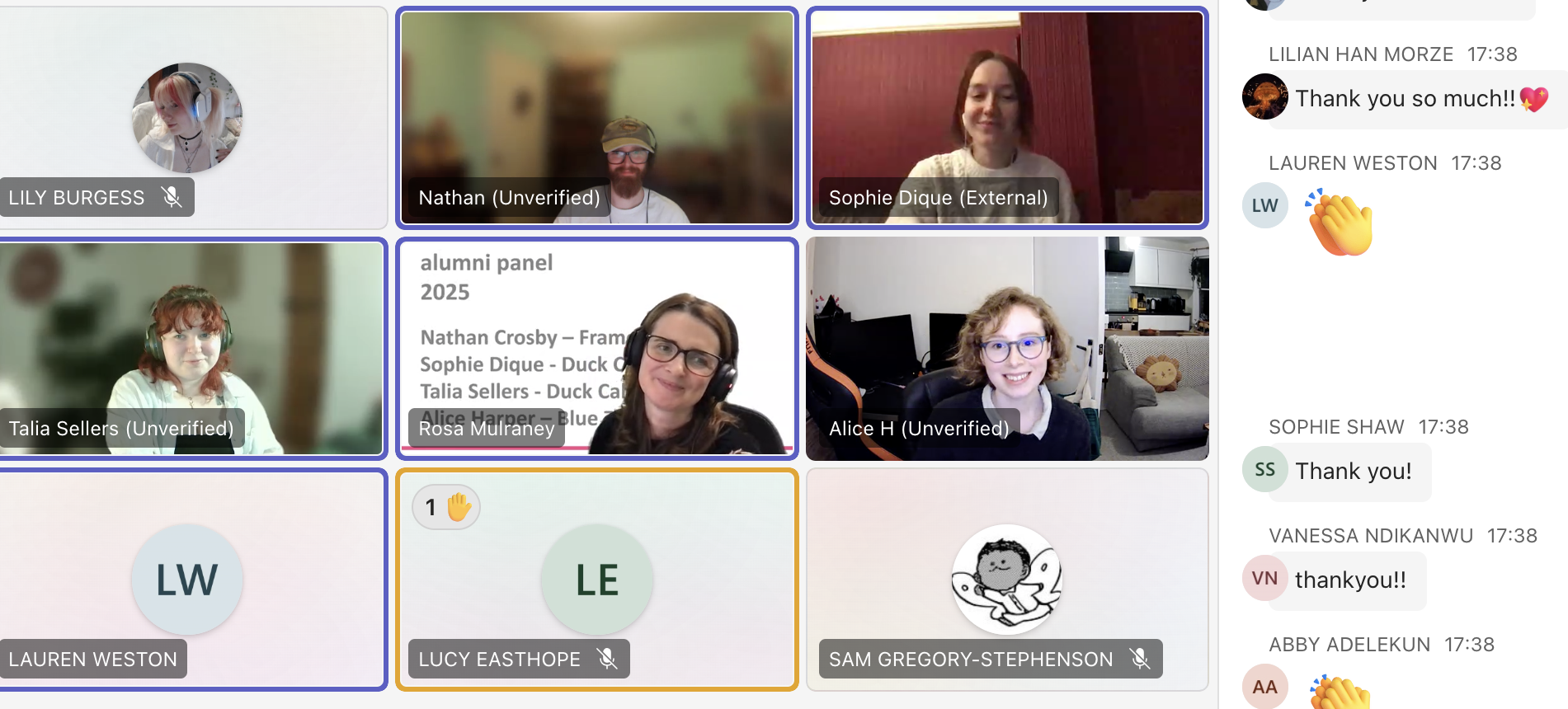
After a happy two hours, with smiles on everyone’s faces and a buzz of excitement in the air, the session comes to a close. We’d like to thank Nathan Crosby, Talia Sellers, Sophie Dice, and Alice Harper for giving up their time to talk with us about their experiences, and of course thank you Rosa for organising the event. Sessions like these really help students to feel inspired and more excited than ever to fly into the industry!