Falmouth University Alumni Panel 2026
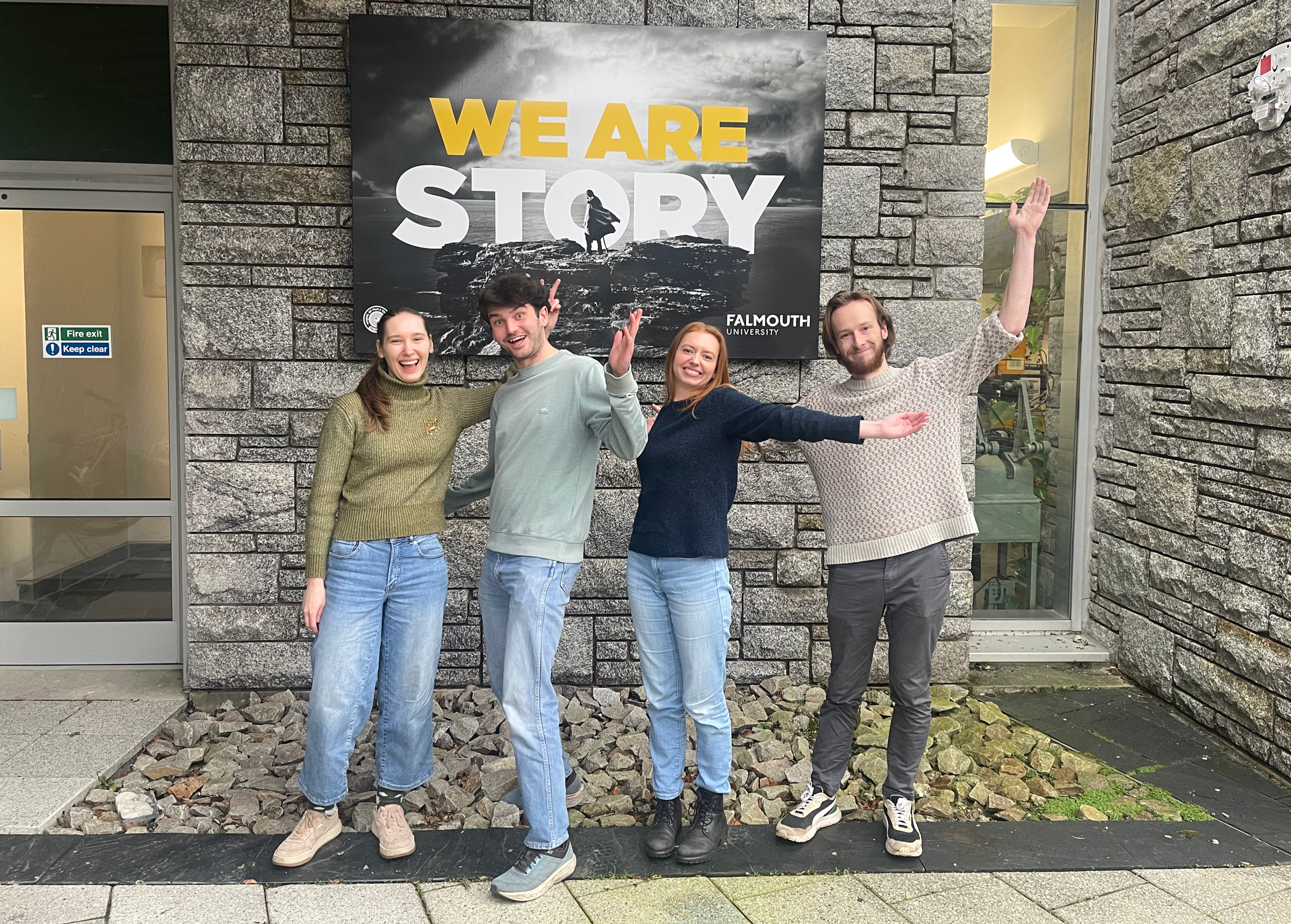
For Falmouth’s 2026 annual Animation alumni panel, both students and staff alike had the pleasure of welcoming the speakers down to Cornwall. Students across all three years streamed into the School of Film and TV’s cinema, chattering excitedly about what the panel members may discuss. After all, these were our successors: the ones who had gone before us, and are now thriving in the very industry we are all hoping to join. With plenty of time ahead to explore a myriad of topics, the room quietened down as the panel formally introduced themselves.
Introductions
Pyran Fisher – Flow/Shotgrid Specialist – Normi
Pyran Fisher graduated in 2021, having worked on his third year film ‘Crispy Love Line’ alongside BAFTA-nominated ‘Middlewatch’ before leaving university. Now he works as a UI/UX designer at Normi whilst supplying his knowledge at a Flow production software specialist. Of course, designing user interfaces isn’t something we study on the course – which just goes to show the breadth of opportunities that can come from an animation degree!
After graduating, Pyran worked on a project called Bal as a producer as well as volunteering as a project coordinator at a company called Breakthrough Careers. Whilst neither of these opportunities led to much, they prevented him from ‘just sitting around’ and provided additional experience outside of university. After all, it’s good to build your skills in one way or another!
His first ‘proper’ job was actually working at Elstree Screen Arts, a school providing film & TV training, before he landed a job at Jellyfish Pictures animation studio: a job which would go on to span across many projects. Pyran shares some insight into these famous projects which he worked on, including a light-hearted joke that working on Wes Anderson films always demanded grain removal despite Anderson’s determination to shoot on film, which produces a naturally noisier result. He also worked on Constellation, Nautilus, and, the most exciting of all to the students: Stranger Things.
After leaving Jellyfish Pictures, Pyran worked at Blink Industry before taking a short break. Much like his time after university, he didn’t want to sit around doing nothing – in fact, Pyran spent this time learning how to code! How might coding play a role in the animation industry, you ask? Well, this knowledge feeds into Pyran’s expertise with Flow, the industry standard animation and VFX production software. Much like softwares such as Microsoft Excel, coding can automate various processes inside Flow and result in a smoother, faster running production. Pyran has since helped various animation studios set up and optimise their Flow projects, with his new skills in coding also coming into play at Pyran’s job at Normi when working on UI/UX design.
Rosa, the chair of the alumni panel, joins Pyran in recommending the use of Flow even for students. Having first heard about it at Annecy Animation Festival, the biggest animation festival in the world, Rosa arranged for the university to get a license – a decision which then enabled Pyran to learn Flow whilst studying here and thus lead to his current career path! It has the monopoly on production within the industry, Pyran assures us, and is worth getting to know for producers and artists alike.
Catherine Donnelly – Compositor – Freelance
Catherine Donnelly now works as an animation compositor – but when she first started studying Falmouth’s animation course, that was far from where she thought she’d end up! Originally, her goal had been to become a 2D animator. This changed once she gained more experience in both 2D and CG animation through her studies, with Catherine joking that she quickly discovered that she found 2D animation to be, well, boring! It was too monotonous, and involved too much drawing of the same thing over and over. She much preferred CG and compositing, and eventually left university hoping to be a VFX compositing artist.
Although Catherine had organised a Canadian work visa for when she graduated, her first job was as an After Effects compositor at Irish studio Jam Media. After seven months spent working on ‘Becca’s Bunch’, it was time for something new: with Canadian work visa in hand, she jetted off to Canada to work as a junior After Effects artist at Atomic Cartoons. This would be where Catherine established herself within her role and the wider industry, working her way up from a junior all he way to lead compositor over the course of four years. The work was largely 2D animation, and involved learning compositing within Toonboom Harmony – something which Catherine recommends learning if you want to be a compositor, as apparently, studios often have to train people in it due to there not being many candidates who already have the knowledge!
In 2023, Catherine returned to the UK and delved into the world of freelance, which is what she continues to do to this day. Freelancing allows for a lot more freedom: she’s had the opportunity to work for all sorts of studios – Blue Zoo, Studio Meals and Elk Studios to name a few – all from the comfort of her home in Devon. This work method means she is never stuck on one project for too long. Her one key bit of freelancing advice? Start looking for your next gig around four months before your current one ends.
Elden – Lead Animator – The Inter Group
Elden only graduated in 2022, but don’t let that fact mislead you – he’s already a lead animator! He describes himself as a 3D generalist who does it all, and currently leads a small group of animators at a marketing agency called The Inter Group. And what is the primary thing he animates there? Why, Jellycat toys, of course!
As lead animator, Elden has many other duties besides animating. Naturally, he leads his team and provides guidance and feedback on their work – but did you also know that the lead animator interacts with the client too? At The Inter Group, Elden attends meetings with both the creative directors and the client, at which they review the work and go through any changes the client may want. Elden must then relay this to his team and ensure the changes are carried out. He tells us that he enjoys his job and is really looking forward to carry on his learning, for it never stops. It certainly seems that there is no ‘finished’ when it comes to developing your skills in this industry!
How did Elden end up as a lead animator so soon after graduating then? Well, he didn’t get into the industry straight away. It actually took him until 2024 to land his first animation job, which was a freelance role at Gizmo animation. Despite this role only being a month long, this was Elden’s way of getting his foot in the door: The Inter Group took him on through his work at Gizmo at the start of 2025. It only took just over a year for Elden to be promoted to lead animator – very impressive! And, with The Inter Group being based up north in Harrogate, it goes to show that you don’t need to be in the big cities to get a good animation job.
Since gaining the role of lead animator, Elden has actually hired multiple other Falmouth alumni to work with him. He reached out to the university to advertise their job openings, and Rosa then publicised the information to graduates. As Rosa says, this is good proof that your network is everything! In fact, four out of the five people Elden hired were through word of mouth. One such person is our final member of the panel, Evelina.
Evelina – Animator – The Inter Group
Evelina Valtere is our most recent graduate on the panel, having graduated just three years ago in 2023! After being contacted by the university about a job opening at The Inter Group, Evelina got her first official animation role in 2025 and now works with Elden as a CG animator. She passionately tells the room that although not getting a job straight after graduating can feel disheartening, it’s entirely normal and not a reflection on your skills so much as it is a reflection on how difficult it is to get into the industry at the moment. Offering some advice on how to stay creative in the meantime, Evelina tells us a little bit about what she did between leaving university and landing her job:
After graduation, Evelina moved to Brighton – somewhere she highly recommends for its colourful arts scene. Even whilst stocking shelves or serving coffees, there is always something creative on the horizon! There, she spent time connecting with the animation community and finding small freelance gigs to do on the side and develop her portfolio with. Behind the scenes events are great to go to, and can provide really helpful insight into the process of professionals which you can then apply to your own work. Evelina’s biggest recommendation, however, is to find and attend BYOA events: Bring Your Own Animation. These casual meet-ups take place in pubs, and provide an opportunity for students, recent graduates, and anybody hoping to develop their animation skills to gain feedback from professionals on their work. Of course, they’re also great for networking! Evelina attended many of these, and found the feedback she got to be incredibly beneficial for her portfolio. She makes a point to stress the importance of maintaining your passion, and keeping that love for animation – or whatever your specialism may be – even when not being paid to do it.
It wasn’t until spring in 2025 that she landed her first interview, and she was incredibly excited. It was with A Productions, a studio responsible for many British children’s shows, and she felt like the interview went really well. However, unfortunately she did not land the job. Whilst obviously disappointing, Evelina puts a positive spin on this, saying that it was still beneficial to gain interview experience: experience which would soon come into play when she interviewed for the job at The Inter Group a few months later! After a successful animation test, she landed the job and moved all the way from Brighton to North Yorkshire. She’s been there ever since!
Q&A Session
What sort of turnaround times do you work to?
Drew, one of Falmouth’s lecturers, laughs at this question: “It’s probably much faster than you guys do at university!”. Catherine agrees, saying that compositing a standard, uncomplicated shot will often take less than an hour. As for 3D animation, Elden says, it really depends on the complexity of the shot. A piece of character animation could take anywhere from a few days to a few weeks – there’s a lot of variables at play.
Likening these timings to our own modules, Drew jokingly tells the students that he wants to see double the amount of work in their next hand-in!
What’s a good first step after graduating?
“Enjoy Falmouth and have fun!” is Pyran’s advice, which is met with agreement from the other panel members. Evelina and Elden both highlight that there is no need to rush into industry – after all, neither of them did. The important thing, however, is to keep developing your skills so that you don’t get rusty. Rosa chimes in reminding everybody that retail skills can still be relevant to creative jobs, with Pyran mentioning that roles such as volunteering at festivals can sometimes even lead to jobs. He got his first job through volunteering at Manchester animation festival, that being the place he got his first contract which in turn led to his job offer. In fact, Drew adds, he himself has hired volunteers from festivals before.
Are you more likely to get a job through a job listing, or through your connections?
The room fills with laughter as Pyran tells a funny story in response to this: when he began job hunting, he posted a fake LinkedIn job listing for the job he wanted so he could see what other people were applying with! Certainly a good reference point, although maybe not advisable.
There is no one size fits all answer to this question: it simply depends. For Catherine, she was able to move onto a project she wanted to work on due to the producer, Cecilia Hay, being another Falmouth alumni from her year. Never underestimate your cohort, she warns! You never know who is going to be the next big director who will get you a job. References, too, can be a great way to stand out.
But even for job listings that you have no connection to, there are ways to make your application more personable. If possible, Pyran advises, try to find and message the person who has listed the job: chase humans, not job posts.
Any other good avenues for job hunting?
Aside from the aforementioned advice on volunteering at festivals, there is one main place that the whole panel points towards: the animation jobs spreadsheet. This spreadsheet, which can be easily found with a simple google, is constantly being updated with new jobs spreading across the entire breadth of the animation field. When using it, you can easily filter results based on location, job role, level of seniority and more. This is going to be one of your most useful resources when job hunting – use it!
Adding to this, Catherine recommends creating your own spreadsheet which details what jobs you have applied for, when you applied for them, and who rejected you if you got a rejection email. This way, you can keep a track of when you last contacted a company as well as having list of the people there who are involved in hiring. There’s no shame to reaching out to them again at a later date.
Finally, of course, the importance of alumni connections is once again emphasised. After all, it’s how Evelina got her job!
From your point of view, how is the job market looking?
Good news for the students! Although we’ve been going through a rough patch, the industry is starting to recover. Covid presented a golden age of animation before things went downhill in the last few years, but studios are slowly regaining their footing.
Of course, the use of AI has been a big concern for emerging animators recently – fortunately, Pyran reckons that it’s starting to “lose its shine”. Whilst it is undeniably a useful tool, it can never be the final product. Elden shares that they do use AI at The Inter Group, but that it certainly requires somebody to drive it.
Does AI play a role in your job?
Following on from the previous question, the panelists delved a little deeper into the contentious topic. Whilst both Catherine and Pyran have had minimal interaction with it – only seeing it used for some concept art and basic code respectively – The Inter Group use it heavily in their work flows:
“The background artists use if for everything. They essentially end up just photobashing things together.”
However, it is not yet being used to make things move. You can’t be exact with it, and so when the client wants one tiny thing to be tweaked, it’s much harder to do with AI than with standard animation. Elden does acknowledge, though, that AI is still developing and may soon become much more powerful in this regard – we will just have to wait and see.
Do you still experience imposter syndrome?
Catherine sums the answer to this question up concisely:
“Everybody gets imposter syndrome, forever. So do things anyway!”
With the start of her first job fresh in her memory, Evelina shares that she felt she was in complete ‘panic mode’ at the start of her job. Reminding herself of everything she had done to get there helped. Rosa echoes this sentiment, recommending the use of keeping a not of the things which you have achieved. In industry, you should expect to get feedback on everything you do: even one round of notes is exceptionally rare.
Before moving on, Drew offers an interesting way to consider feelings of imposter syndrome: he says that you should never really feel comfortable in your first four years in industry, because your manager should be pushing you! So, perhaps an alternative way to look at those feelings is to consider them as truth that you’re simply being pushed to your full potential.
With all questions answered and a room of inspired and excited students, the session came to a close. Students were then lucky enough to give the panel a tour around the studios before getting to catch up with them on an individual basis in studio 1, where they all divulged their knowledge and provided invaluable feedback on our work. A massive thank you goes out to Pyran Fisher, Catherine Donnely, Elden Theaker and Evelina Valtere for giving up their time to come and see us all, and an additional thanks to Rosa for hosting the panel. What a fascinating insight into what awaits us on the other side of university!