The Secret Jobs of the Producer: running a marketing campaign
As students, we have no guaranteed source of funding to make short films. Instead, in order to create a pot of money to budget with, I have gotten into the flow of running Kickstarter campaigns.
My first campaign – for ‘Space Sweepers’ (Lilian Han Morze, 2025) – was pretty basic. As we were working to quite a quick turnaround (see my blog post ‘Taking a Short Film from Start to Finish in Ten Weeks’), we organised for music, voice actors and sound design to be completed in-house by fellow students. This, fortunately, meant we didn’t have to pay for it. Our Kickstarter raised 150% of our goal (£300) which we then used for festival entries. A worthwhile thing to spend it on!
My final year film The Best Part, however, was a much larger endeavour.
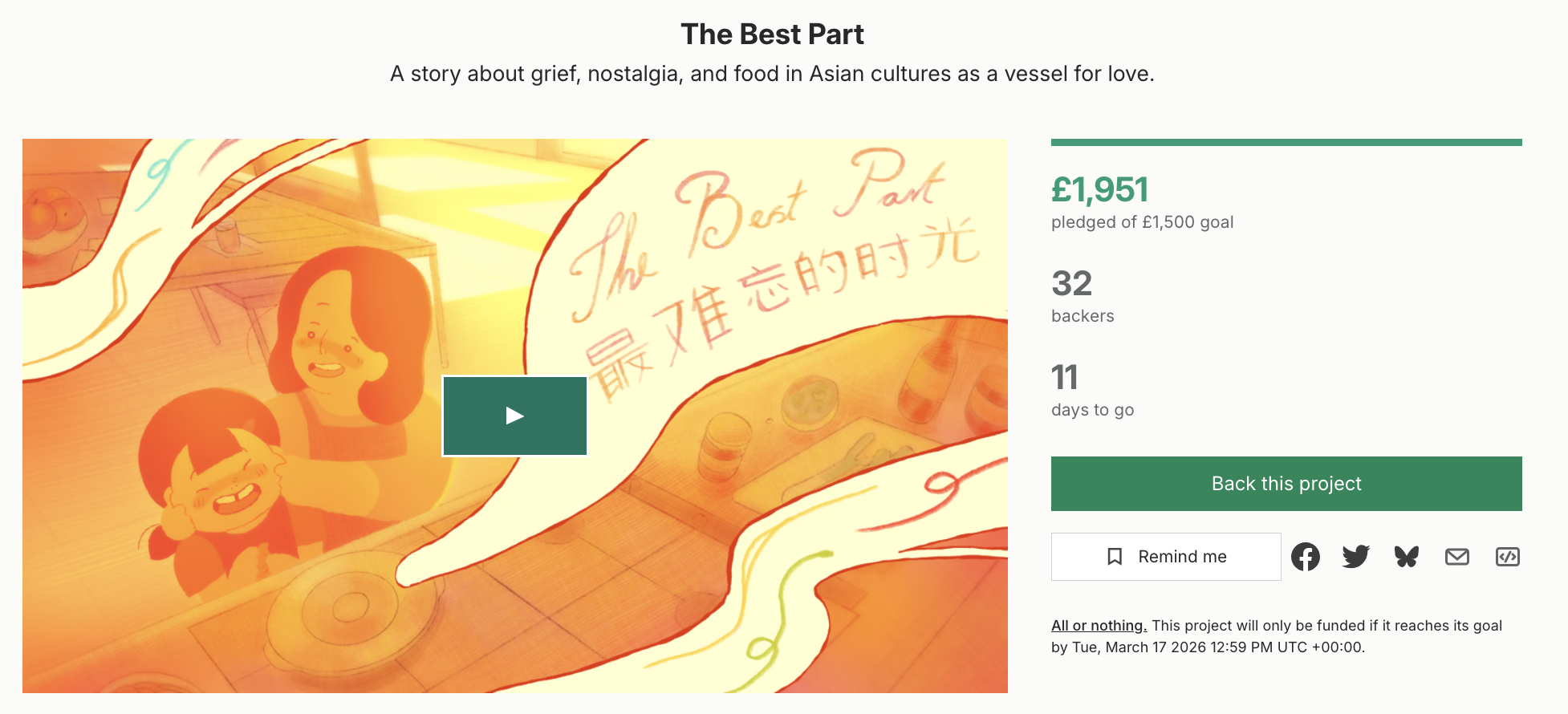
As you can see above, our Kickstarter was a success. This was the result of months of planning and hard work! So, what went into it?
We had far higher costs for this film, with over £1,000 going towards external collaborators – a lot of money when you’re starting from scratch as a student! As such, we set our initial goal at £1500 with hopes of raising more.
The most important part of running a Kickstarter campaign, I have found, starts far before your Kickstarter launches: you need to build hype around your product. We announced our Kickstarter several months before it went live – although in retrospect I would have started even earlier. The key factor is to have people invested in the film and excited to donate to it on launch day. Alongside the director we crafted two target audience profiles for our Kickstarter: the digital art/animation fan, and parents who could relate to the themes of the film (particularly Asian ones, as the film is influences by Asian cultures).
My main method of marketing was through social media, having created an instagram account four months before our kickstarter launched. With a regular posting schedule, tailored to our ‘animation fan’ target audience, I built a community who were invested in the film’s success and who were counting down the days to the launch date. Instagram also boasts many analytical features which helped me to sculpt our posting scheduling. Other channels that we built a following through included social media sites such as Facebook and Reddit – targeting parents and animation fans respectively – as well as putting posters up locally. Across social media, our community grew to 1,000+ followers with 10,000+ likes and 65,000+ views.
Prior to launch, the main push was to get potential investors to ‘bookmark’ our Kickstarter project. This allowed me to send out emails to our interested audience, which I used to keep the project on their minds as well as to alert them as we got closer and closer to the project going live. Once a project hits 12 bookmarks it will display this publicly on Kickstarter’s website, which can also makes the project appear more attractive and encourage people to join your existing group of supporters. I also set up separate links for when we shared our Kickstarter, allowing me to track what avenues people found the project through so I could gain insight into where we were succeeding most.
Having done all this work, we ended up surpassing our goal on launch day. Although I had to familiarise myself with various concepts and best practices within marketing, it was ultimately an incredibly rewarding experience. And who knows – maybe the next time I make a Kickstarter, I’ll end up with millions!